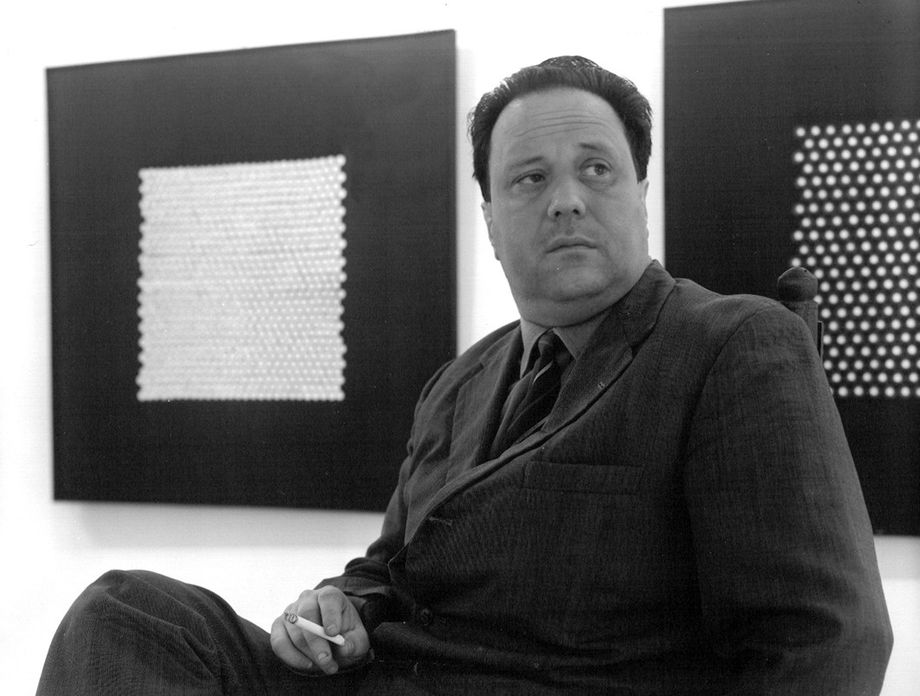
Gastone Biggi was born in Rome on February 12t ͪ 1925, (about himself he says: "I’m an ancient Roman, I was born and I lived in the shadow of the Coliseum"), in the mythical Rione Monti, where Julius Caesar, Petrolini and Apollinaire were also born. He attends Liceo Artistico and there he teaches, in different schools, until 1984. During the war he is a prisoner of the German army; in 1946, while recovering for the tortures he underwent, he begins painting at Sondalo hospital.
In 1949 and 1951, introduced by Mario Sinibaldi and by music professor Riccardo Milano, he shows his artworks at Galleria Fiorani in Rome, where he also shows Gli ignoti 1948, which will give him the inspiration for his theory of Abstract Realism.
A foreboding of what was to come, but which interrupts his idea of only realistic figurative painting. There blooms his interest in music. His compositions will draw upon the world of music notes (Bach above all).
In 1950 he takes part in Premio Michetti with the painting Periferia, of social inspiration, and the critic Ugo Moretti notices his work. The following year he travels to Paris, the first of a long series of journeys where, systematically, studying and painting intertwine.
After his return he re-establishes a relation with the Roman context; he meets Igor Stravinsky on his fìrst concert in Rome; he sees the artists of Scuola del Portonaccio (among them Buratti, Muccini and Vespignani), and later he meets the painters with whom he will create Gruppo 56 and then he will show his artworks together at Galleria La Finestra in 1957.
In 1952, encouraged by Irene Brin and Gasparo Del Corso, he shows his pointillìste paintings at Galleria l'Obelisco in Rome, and he creates the scenes for Aristophanes's The Birds at Teatro delle Maschere in Rome. At this point he begins his commitment as school teacher.
In 1956 his solo exhibition at Galleria Il Pincio, where his artworks had already been on show in 1955, presented by Stefano D'Arrigo and Giulio Picciotti. In 1957, after the execution of works under Giotto's influence, ends the phase of Biggi's social realism: with Le Cancellate, on show at Galleria II Camino, Rome, in 1957, introduced by Renato Giani, and above all with 1958 I Racconti, Le Lettere and Le Sabbie Biggi comes close to Informal painting, on show at La Tartaruga, Rome, the same year: using fragments of matter and memory, he tends to create the very surface of memory.
Italian television dedicates him a radio program: Ultimo quarto, on air in 1960, edited by Giovanni Artieri and Renato Giani, with the title Gastone Biggi e la Vespa, the scooter with which he travelled throughout Italy, going so far as to reach Berlin in 1967; in the meantime he comes into contact with the authors of Forma 1 (Dorazio, Scialoja,Turcato, Perilli); in 1959 he shows his Racconti and Sabbie at Galleria Dìscotheque, and in 1960 he comes in contact with Giulio Carlo Argan who, together with Palma Bucarelli, Lionello Venturi and Nello Ponente, is particularly keen on similar research; with them he starts a long relationship of respect and friendship.
He gets several awards and didactic tasks (he teaches Advertisement & Design at Diaz School in Rome); he resumes his journeys to France, deserts Informal art and comes back to shapes and form with his Continui segnici, abolishing colours and painting solely in black and white, in Genoa, where he meets Roberto and Rinaldo Rotta.
His first abstract paintings (Continui, Omaggio a Bach) are on show at L’Arte di Roma e Lazio (later called Biennale Romana); in 1962, together with Frascà, Carrino, Santoro, Uncini and Pace, he creates Gruppo 1, whose artworks are on show for the first time at II Quadrante, Florence, and at Galleria Rotta, Genoa; in April 1963, he shows his works with Gruppo 1 at the IV Rassegna of Rome and Lazio at Palazzo delle Esposizioni; he takes part in the meeting Scelte e proposte. Musica Poesia Pittura in L'Aquila, with chairman Giulio Carlo Argan, with Gruppo 1 and composers of contemporary music, from Stockhausen to Clementi and Berio, and also with Gruppo 63, with Sanguineti, Giuliani, Balestrino, Porta and Vivaldi. He is on show with Gruppo 1, in 1963, and participates in the exhibition Oltre l’informale, in the Republic of San Marino, curated by Argan: with Gruppo 1 he is awarded the 2nd Premio Internazionale. On that occasion he meets Pier Francastel, he takes part in Convegno of Verucchio, July 1963; he reads Gruppo 1 Dichiarazione di poetica. Gruppo 1 strengthens its activity based on the creation of a 'task force' where the painter, even though maintaining his own characteristics, may confront other forms of art, music in particular.
Later on Biggi displays with Gruppo 1 in Galleria La Medusa, Rome, and then in Monaco, New Delhi, Nijigata, Hamhel. He is awarded, ex-aequo with Schifano, the First Prize of Ministero della Pubblica Istruzione.
In 1964 he collaborates to the writing of the second manifesto of Gruppo 1, Poetica della percezione, for the exhibition at Galleria II Cavallino, Venice, where he makes the acquaintance of Luigi Nono and Emilio Vedova. During the Biennale, he meets Louise Nevelsen in Venice. In 1965 he ends his collaboration with Gruppo 1, and takes part in the IX Quadriennale Nazionale Romana. In 1966 he starts working on his Variabili, and participates in an important exhibition of contemporary Italian art, Italian Art of XX Century, at Baltimore Art Museum as well as to Italian Abstract Art, Gibson Foundation, Chestertown, USA. In 1967 he publishes, edited by Foglio publishing house, Nascita di un punto, 1962; his artworks are on show at Galleria Carabaga, Genoa, at Cortina d'Ampezzo Circolo Artistico, at Cagliari Centro Culturale, presented by Corrado Maltese, and at Galleria II Bilico, Rome, presented by G. C. Argan, Aldo Clementi and Piero Dorazio; he paints four big paintings for the sanctuary of Collevalenza (Todi), commissioned by the
great Spanish architect Lafuente. In 1967 he is awarded Premio Finmare (Premio Michetti). He is in close relationship with Rosario Assunto and Goffredo Petrassi.
In 1967 Biggi travels throughout Europe: Germany, France, Austria, Norway, Switzerland and Sweden, as far as Russia. His pictorial quest changes, he moves on towards discoforme with the series of Variabili; after years of black and white, he goes back to colour. The early Seventies see him abroad, where Biggi's solo exhibitions begin to multiply. Nonetheless, his commitment to music and writing, Biggi's greatest passions, is inaltered.
In 1968 he is invited to VI Biennale Romana at Palazzo delle Esposizioni and to Biennale di Passignano by Nello Ponente, and he will introduce his solo exhibition at Galleria Stamperia del Foglio, Rome (Aprii 1969). The same year he takes part in the exhibition of the new artists of Galleria Nazionale d'Arte Moderna in Roma, and in the artistic review Coincidenze, first in Massafra, and then in Florence andTurin.
In 1970 he is awarded the XV Premio Termoli; he shows in different Spanish locations within the artistic review Pittori Contemporanei Italiani in the museums of Madrid, Barcelona, Valencia and Sevilla. In Rome he meets Jean Paul Sartre,Rudolph Arnheim, Hans Hartung, Galvano della Volpe and Murilo Mendes, who will write: " the paintings by Gastone Biggi help me to live...".
Since 1970 he has collaborated with daily L'Umanità, with his column Azzerando. In 1971, besides his rich expositions - he also shows at Galleria Contini, Rome, presented by Cesare Vivaldi and Murilo Mendes, and at Galleria Morone, Milan - he sees into the writing of Almanacco dei Poeti, invited by Guido Ballo, he gets directiy into Milanese context; he takes part in the exhibition Scrittura-pìttura with Schifano, Angeli, Festa, Kounellis, Twombly and Novelli, at Galleria Contini, Rome. In 1972 he displays his artworks in Venezuela (Ciudad Bolivar), in London (at Bertrand Russell Centenary International Exhibition), in Madrid (at XX Salon di Grabado Contemporaneo), and in different Italian locations with three group exhibitions presented by Paolo Fossati (Galleria Mantra in Turin, Galleria Rondanini in Rome, Galleria Morone in Milan). He then shows his paintings at Galleria Ferrari in Verona; in 1973 he is at X Quadriennale in Rome, where Palma Bucarelli purchases, on behalf of Galleria Nazionale d'Arte Moderna di Roma and of Galleria Comunale di Roma, three big paintings, there on show.
He is awarded fìrst prize in Termoli (CB).
After arguing over Variabili, bringing them to chromatic exasperation, he goes back to white (light), grey (time), black (origins), marked by graphite, in the series Continui secondi.
In 1975 he begins writing the book Bisny. From Byzantium to New York; by the mid Seventies, his quest reverts to circles and tangents, studying the possibilities of highlighting with stamps and matter, by means of sign incidences: his Tangenziali come to life, made only of scanty chromies.
In 1976 he is the headmaster of Liceo Artistico in Ravenna, where he gives important critical contributions. In 1977 he starts painting the series of great-dimension Ritmi, still in black and white, and he will carry on for more than two years; in 1978 debuts his Cieli series, and he moves to Marina di Ravenna.
With his Cieli he resumes the full use of colours, charged with the use o pastels and wax. This theme will be developed for the years to come, showing his artworks throughout Central and Northern Europe, appreciated by viewers and critics. In 1980 he comes back to Rome; his latest production is on show at Galleria Editalia, presented by Nello Ponente, where he makes the acquaintance of Fausto Melotti and Mauro Reggiani. He is invited to display his paintings at the artistic review Linee della ricerca artistica italiana in Rome, Palazzo delle Esposizioni, curated by Nello Ponente and Claudia Terenzi. In 1981 he shows his first Cieli at Galleria Spatia in Bozen, presented by Luigi Lambertini, sided by his Cieli secondi, an evolution of the former series, and he writes for Salzburg magazine Literatur una Kritik a collection of poems dedicated to Schubert and Vienna. After a long journey through France, in search of inspiration from Romanic and Gothic art (he develops a strong passion for Chartres stained glasses), he begins painting I Giorni, artworks of great spontaneity and immediacy. In 1983 he shows his series Giorni at Galleria Mèta, Bozen, presented by Luigi Lambertini, and at Expo, Bari, with Naples Galleria Lo Spazio.
In 1984 he leaves Rome to settle down in Siena countryside, in Valacchio, and leaves teaching as well. These landscapes will be the new experience clearly visible in Cieli evolution, and most of all in the following cycle I Campi, 1985, where the warp of signs and colours tends to reflect the innumerable vibrations of light, so as to portray the emotions experienced by the artist.
In 1985 he takes part in the Mostra Italiana negli Anni Sessanta in the collections of Turin Galleria Civica d'Arte Moderna, Castle of Rivoli. In 1985 in Rome, he collaborates with Spazio Documento, with a series of lectures on the relationship between music and painting. In 1987 he is invited by the towns of Lunigiana (Arcola, Sarzana, Bocca di Magra) for a series of events connected to the constitution of Museo della Bassa Lunigiana. After three years spent in the area of Siena, he comes back to Lazio and he settles down in Genzano, Rome, where he starts his Canti della Memoria, conceived with absolute freedom, while he tries to connect the abstraction of ideas with the reality of vision and memory, in a sort of figuration where are present elements taken from most objective visual catalogue, though transfigured in the very act of realization by culture and operational experience.
In 1988 he shows for the fìrst time his series of Campi at Galleria Comunale, Genzano. His artworks are also on show in Bologna. Galleria Spazio, in Imola in the Cloisters of St. Domenico, and we shall also quote a group exhibition in Nemi, Palazzo Ruspoli, presented by Mariano Apa and Paola Serra-Zanetti.
While in Genzano Biggi conceived his Canti della Memoria and his Luci, his coming back to blue, hues typical of the fresh air and blue skies of Colli Albani.
Biggi continues his travels. Of great importance is his long stay in America, where the magnificence of Manhattan skyscrapers and the black hardness of suburbs strike him particularly.
In 1989 he is invited to the exhibition at Rome Università La Sapienza - Orientamenti dell'Arte Italiana 1947-1982, curated by Simonetta Lux. That year he writes Suite Americana and New York-New York; in 1990 he shows his series Le Luci in Verona, Galleria Cinquetti, in Milan Gallerìa Spazio Temporaneo, presented by Paola Serra-Zanetti, in Cavriago, Galleria Comunale, presented by Elena Pontiggia. Finally, he takes part in the artistic review Roma Anni '60, curated by Maurizio Calvesi. In those years he collaborates with the art magazines Art Leader and Terzocchio.
In the spring of 1990 he moves to Milan: in his new studio he works again on his Luci, conceived after his American experience and enriched by his Milanese stay. Milan and its rigorous atmosphere inspire his Tabule, a series where the background is the true focus of the painting.
Those years he intensifìes his relationship to Rodolfo Aricò, Carmelo Cappello, Walter Valentini, Valentino Vago, Mario Raciti, Claudio Olivieri, and Luciano Caramel. In 1991 more exhibitions in Milan (he presents his Continui at Spazio Temporaneo, presented by Luciano Caramel) and in Verona (he shows his artworks at Galleria Cinquetti, presented by Vittoria Coen); he takes part in the show Nove artisti Italiani in Strasbourg, presented by Patrizia Serra; in 1992 Elena Pontiggia invites him to the artistic review Il Miraggio della Liricità, organized by Comune di Milano, also displayed in Stockholm, where he presents 1988 Canti della memoria in a solo exhibition at Art Galerie. He travels to Ireland and Spain.
Biggi's wanderings continue through 1992: he moves to Verona, where he gets the inspiration for a new artistic path: his Costellazioni.
Every journey is for Biggi a moment of enrichment and reflection, both for his paintings and his writings. Bora publishing house publishes Bisny, presented in Brera, Milan, by Elena Pontiggia. In 1993 he resumes his work on Costellazioni, exhibited in 1994 in Verona, Novara, and Bologna, with a solo exhibition at Arte Fiera. In September 1994 he settles down in Langhirano with painter Giorgio Kiaris, his assistant and collaborator. With Kiaris he starts organizing art shows, debates and lectures. In 1995 he shows his artworks at Centro Steccata, Parma. In Bologna, Bora publishes his hook lo, gli anni'60 ed il Gruppo 1. In March 1995 he begins working on the series of Icone, where he resumes the use of sand and sawdust, in almost solemn and hieratic way. At the same time, the project of Anno Padano takes form, mirroring the moods, the lights and the passions of Emilia, the place where he now lives. Those same feelings are at the basis of the creation of
tour big paintings devoted to the seasons. In 1996 he is awarded the I Premio Sulmona for painting. In 1997 and 1998 his exhibitions Galleria Edieuropa, Rome; he starts painting his Icone metropolitane and he participates in the artistic review in Termoli, Gruppo 1 1962-1964, curated by Luciano Caramel and Patrizia Ferri. He is also awarded I Premio Sulmona for art criticism. After a brief parenthesis inspired by the surrounding landscape, Biggi begins his series Diari, whose purpose is to re-establish the necessary contacts preventing the work of art from being static, and letting it follow social themes, so loved by this artist. In 1999 the publishing of Autoritratto 1947-1999, curated by Marco Tonelli, for solo artistic review Palazzo Ducale, Colorno, and at Centro Culturale, Langhirano.
In 2000 he begins his Cosmocromie, presented in Montecassiano, at Piazza delle Erbe Private Art Gallery, and at Galleria Vinciana, Milan, by Elena Pontiggia and Eugenio Miccini. In 2002 he displays his Cosmocromie 2000-2002 at Centro Culturale, Langhirano, curated by cultural councillor Maria Elisa Canali; the same year the Pinacoteca Comunale of Calasetta (Cagliari) acquires one of his paintings (Variabile monocroma). In 2004 an art exhibition in Mantua, Casa del Mantegna, within the group exhibition on Italian painting in the second half of the XX century, L'Incanto della Pittura, curated by Claudio Cerritelli.
The friendship and fertile critical and artistic collaboration with Arturo Carlo Quintavalle will be the occasion to give the CSAC of Università di Parma a series of graphic and pictorial works shown at Scuderie della Pilotta in September 2004, and presented in the text Gastone Biggi, Skira Editions, by A. C. Quintavalle.
The same year, in Brescia, a restrospective exhibition entitled Testimoni a favore at Galleria Arttime marks the beginning of the relationship and friendship with Marzia Spatafora and Francesco Boni.
In 2005 with Maretti publishing house he publishes the hook Incursioni d'artista, for his shows in Monte-Carlo and at GAM in Faenza, in cooperation with Galleria Arttime in Brescia. Of great importance his latest output: his Incursioni d'artista and Eventi, inspiring in 2005 the writing of Manifesto del Realismo Astratto, with which he lays the foundations of his life-long research within the interpretation of painted works, abolishing the severance between abstraction and realism, both heading towards the same direction. He writes “ln my latest research, that is in my Eventi, l've tried to fìnd the clue of a lost reality, [...] not a restoration, [...] but a forward motion just like this, that l'd
like to define Abstract Realism, where all the representations of reality, filtered by abstract grammars, come to us under a new and original light, "0nce more, Biggi denies the supposed death of painting with the only means that a painter possesses: by painting. His obstinate looking
for pleats, nuances, for the highest and deepest notes of colours, has this meaning: showing that painting does neither have to be actual, nor modern, because art is eternal; he states that "the world does not need ancient or new sorrows, what the world needs is new serenity and new beauty".
In June 2006 at GAMeC Gallerìa d'Arte Moderna e Contemporanea, Bergamo, he takes part in the exhibition Debutto d'artista: Premi d'incoraggiamento 1942-1964, curated by Rorro and Barbato.
In Decomber 2006 at Venice Fondazione Riva, he previews the cycle of paintings entitled New York-New York 1989- 2006, publishing on that occasion the book containing them, presented by Claudio Cerritelli and which will be on show at 2007 Bologna Arte Fiera and in Brescia, Gallerìa Arttime . The New York cycle is realized on sanded canvas and with thè insertion
Of multi-shaped collages.
In March 2008 he publishes his hook Minimilano, Silvia publishing house, a notebook with poems and gouaches about Milan, and his novel Anelio (a Milanese story). He opens at Casa del Pane, Milan, the show E la pittura continua.,.60 anni di pittura: 1948-2008, curated by Gianluca Ranzi (catalogue Christian Moretti), summarizing the artistic adventure of his complex path, where he previews his series of Ayron, begun in the summer of 2007, paintings characterized by the dualism between sign and shape. In September, in Fortezza Firmafede, Sarzana, he takes part in the exhibition Gli anni del LAB: L’esperienza del Laboratorio di Arte Contemporanea della Lunìgiana, curated by Mara Borzone and Sandra Solimano (Museo di Arte Contemporanea di Villa Croce, Genoa).
In 2009 he is invited to 53 ͬ ͩ Venice Biennale d' Arte, and he shows his series of Puntocromie in the prestigious location of Palazzo Zenobio, Collegio Armeno; the title of the exhibition is Datemi un punto d'appoggio e vi dipingerò il mondo, curated by Marzia Spatafora and presented by Elena Pontiggia. Gastone Biggi here compares his famous Continui with more recent Puntocromie, nothing but an evolution of the same work, read in way closer to present reality. In December he publishes thè book Tutta un' altra storia.... edited by Studi Uniti, an ironic revival of history, from the origins to present days.
In January 2010, in Rome bookshop Fontanella Borghese, the viewers are introduced to the volume (published by Christian Maretti) dedicated to Venice Biennial Exhibition, with Elena Pontiggia and Gastone Biggi. He starts painting his Fleurs series, works of art inspired by flowers, yet bearing imaginary titles and nouns, as if the artist had written a new botanic ABC book. These paintings, extremely new and fresh, enclose in a unique essence the concept of Abstract Realism after the experience of his Puntocromie. In September 2010 he opens in the rich salons of Palazzo Sant' Elia in Palermo, under the aegis of the Province of Palermo, his solo exhibition entitled Gastone Biggi. Attraversamenti. This exhibition is organized
by Marzia Spatafora, is curated by Francesco Gallo and is presented in the catalogue (published by Christian Maretta) by Gianluca Ranzi. It is an important anthological exhibition, thanks to the simultaneous presence of his first figurative paintings and his latest Fleurs, the debut of his cycle Guerra e Pace, belonging to Eventi series. He writes about his life in Rome before 1960, a fundamental experience, even more important than the years to come; in December 2010 he publishes his book Gli anni '50 - La svolta, presented at Bologna Arte Fiera in January 2011.
In September 2011, Gastone Biggi Shanghai, solo exhibition curated by Gianluca Ranzi, at the Urban Planning Exhibition Center, in Shanghai, China. This show displays all his big paintings, together with the Fleurs he paints for this special occasion (catalogue published by Christian Maretti); in December he takes part in the artistic review Tra figurativo astratto e nuova figurazione at Museo del l'Arciconfraternita dei Genovesi, Cagliari, curated by Daniele Lastretti.
In July 2012 at Museo di Villa Colloredo Mels, Recanati, he takes part in thè artistic review La casa di Peschi, group exhibition of artworks by international Maestros, curated by Roberto Rossini and Laura Melone. In December he publishes his book II Realismo Astratto, Fenomelogia e Cause, a cultivated and rich essay about Gastone Biggi's conception, where he gets over his personal history, devoted to the continuous quest for what has inspired his Abstract Realism from 1949to date.
In December 2012, in Padiglione B di MAGRO Testaccio, Rome, he organizes his show Dalla collezione MAGRO, a selection of paintings from the permanent collection of the Museum. The initial part of the exhibition collects a core of paintings by historic artists, such as Mario Ballocco, Gianfranco Baruchello, Gastone Biggi, Enrico Castellani, Sergio Lombardo, Titina Maselli and Claudio Verna; these artworks are marked by formal research, dedicated to the study of geometric and chromatic components and, more generally, of pictorial surface. These paintings witness to what extent Italian artistic quest, in particular during the Sixties and the Nineties, has contributed to the renewal of abstract trends, leading to the overcoming of pictorial two-dimensionality through the use of colour and the modulation of the means.
In March 2013 in Spoleto Gianluca Marziani is the curator of the show at Palazzo Collicola, Gastone Biggi's anthological exhibition retracing the project presented at Shanghai Urban Planning Exhibition Center, in 2011. In Spoleto the cycles are developed according to the time progress of Biggi's long and fertile career, covering a span of time ranging from the Sixties, crossing the decades to reach present time. In the last part of the show, the great cycle dedicated to New York, organized in Galleria del Piano Mostre.
In september he wishes to come back to France, in the Bordeaux region, and he decides to travel with Giorgio Kiaris and Arch. Fiorella Giuliodori to visit also Charentes, Limousin, Auvergne and Dordogne regions.
In December 2013 an anthologic selection of his works dedicated to New York are presented at Whitebox Art Center in New York, exhibition curated by Gialuca Ranzi and Marcia E. Vetrocq, catalogue edited by Christian Maretti, presented at New Museum, New York.
Towards the end of 2013 and throughout the beginning of 2014 he paints big charts following the theme named “The Village”, a sort of travel book of the last experiences in France, he writes the book “Morte e trasfigurazione della pittura contemporanea”, an in depth analysis of contemporary society and art, compared to a past which seems to be so far away, published posthumous by Piazza delle Erbe publishing company.
Among his many cultural activities, he lectured and debated about Art, he taught lessons and seminars in the most famous Universities and cities in Italy.
He dies in 2014 at Casa Rossa di Tordenaso, on the hills near Parma.
In 2015, the Gastone Biggi Foundation was established at the artist’s house and studio Casa Rossa (Red House) in Tordenaso (PR) to preserve and promote the legacy of the artist. The following year, in 2016, the first posthumous solo exhibition was held at the Civic Museum of Villa Colloredo Mels in Recanati (MC), showcasing works on paper spanning from 1948 to 2014. Curated by Ubaldo Sagripanti and Lucio del Gobbo, the exhibition was accompanied by a catalogue published by Piazza delle Erbe Editore.
In 2018, Skira Editore released the Catalogue Raisonné of Paintings, edited by Arturo Carlo Quintavalle and Gloria Bianchino, which was officially presented in 2019 at the National Gallery of Modern and Contemporary Art (GNAM) in Rome.
In 2021, as part of Parma’s designation as Italian Capital of Culture, the exhibition Luce degli Appennini (“Light of the Apennines”) was presented at the Reggia di Colorno (PR). Curated by Gloria Bianchino, the exhibition explored Biggi’s abstract interpretation of the landscape, accompanied by a catalogue published by Sagep Editore. That same year, the Municipality of Cagliari organized and promoted a major retrospective titled Il canto sospeso della pittura (“The Suspended Song of Painting”), curated by Claudio Cerritelli, with the exhibition catalogue published in 2022 by Edizioni Musei.
In 2022, the Casa Rossa, headquarters of the Gastone Biggi Foundation was officially recognized as part of the Houses of the Illustrious heritage network of the Emilia-Romagna region.
From 2022 to 2025, the Poliart Gallery in Milan hosted a trilogy of thematic exhibitions entitled Gastone Biggi – Trilogy 1-2-3, curated by Leonardo Conti and Giorgio Kiaris. These exhibitions retraced the artist’s most significant creative cycles from 1960 to 2013 and were accompanied by a box set of three catalogues published by Edizioni Poliart.
In 2025, to mark the centenary of Gastone Biggi’s birth, the national celebrations BIGGI100 – Art, Education, and Poetry of Gastone Biggi will take place across multiple cities including Parma, Genzano di Roma, Rome. The program will feature major retrospectives, scholarly conferences, and a rich calendar of musical and poetic events dedicated to celebrating the artist’s enduring legacy.