“Life is a dance in the crater of a volcano: it will erupt, but we do not know when.”
— Yukio Mishima, Spiritual Lessons for Young Samurai (1968–1970)
The work of Filippo Moroni (born in Castiglione del Lago in 1996, lives and works in Milan) moves along a subtle, almost imperceptible line that lucidly cuts through appearance and corporeality, the body and disguise, strength and fragility.
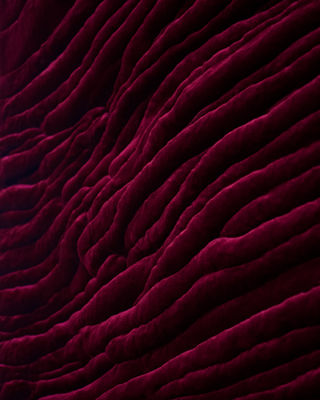
In this new body of work — defined by a precise chromatic palette that ranges from burgundy red to golden yellow, from deep azure to the most abyssal shade of emerald green, all the way to intense black — the artist explores, through both a physical and emotional gesture, the profound tensions of identity, shame, and desire: universal themes that manifest hic et nunc through matter itself, ever-living and pulsating.
Everything begins with a raw, almost trivial material: polyurethane foam, which grows and deforms like an autonomous creature, irregular and unpredictable, eluding any attempt at control. Yet Moroni does not seek to tame this rebellious substance; he confronts it directly. He strikes it, shapes it, challenges it in an intense and deeply personal struggle. The artist’s body engages with that of the material in a dialogue-clash that speaks of control and surrender, resistance and release — a succession of physical and psychological tensions that culminate in a truly embodied experience.
Here emerges a symbolic parallel with the phenomenology of the body theorized by Maurice Merleau-Ponty, according to whom — in his Phenomenology of Perception — the body is not a mere object, but a lived subject: a sensitive locus where experience and meaning intertwine, opening the individual to the world. Moroni’s work seems to embody this principle, where matter is no longer inert substance but flesh that speaks — that becomes presence and resistance. In his bodily contact with polyurethane, the artist crosses that existential threshold identified by Merleau-Ponty between subject and world, between perception and the lived body, revealing the dialectical and embodied nature of identity.
Then comes velvet, the quintessentially Lucullan material: soft, sensual, elegant — yet ambiguous, the supreme symbol of decorum, opulence, and seduction. It does not merely cover what lies beneath — the polyurethane — but envelops and restrains it in a precarious balance; it both protects and exposes. Velvet thus becomes a metaphor for a contained rage and a tenderness that wounds or is wounded: the final layer left after trauma, when the surface transforms into mask, skin, armor.
Velvet Rage thus emerges as the space where turmoil takes shape, and form turns into language, giving voice to what often remains inexpressible.
This artificial layer of skin inevitably recalls Jean-Paul Sartre’s reflection on the Other as a source of gaze, judgment, social masks, and condemnation. In Being and Nothingness, Sartre describes how identity is built upon the need for representation: a mask concealing a vulnerable self, in conflict with its own freedom. Identity, for Sartre, is not an innate given but a process in constant becoming, grounded in freedom and individual responsibility. The individual, “condemned to be free,” defines themselves through their choices and actions. In this light, Moroni’s velvet becomes not merely tactile matter but a device of both defense and exposure: a space where the self endlessly prostrates itself, oscillating between the desire to reveal and the impulse to conceal.
Consistently, the exhibition’s title — borrowed from Alan Downs’s The Velvet Rage — transcends its literal reference to propose an alternative interpretive key that illuminates its psychological and universal reach: “Every perfection you see is a mask, a construction to keep the scream inside.” Perfection thus becomes a mask; luxury, a glossy, soft, and seductive surface concealing a primordial, uncontrollable force that throbs relentlessly beneath.
This dichotomy between surface and substance partly recalls Friedrich Nietzsche’s philosophy, which, in his reflections on the mask and the Dionysian, suggests that appearance is not mere illusion but a form of art in itself — both protection and expression. Nietzsche invites us to recognize art as a manifestation of the will to power, capable of transforming suffering into creation and shame into vital energy. Within the exhibition, this creative energy becomes palpable, manifesting in the tension between what is revealed and what withdraws from sight.
Moroni’s work moves precisely along this liminal zone, on that ridge where appearance desperately attempts — never quite successfully — to conceal the formless, the excessive, the unassimilable.
Indeed, as the artist himself states: “It’s a battle between what covers and what refuses to be covered. Between surface and substance. Between appearance and urgency.”
These words resonate with the thought of Guido Ceronetti, who wrote that “pleasure unites bodies, pain unites souls” — where the body may appear as a miracle of flesh, and yet the flesh remains an abyss of shame.
From these premises, in this new corpus of works, substance itself becomes flesh — living, pulsating flesh that, like shame, lays itself bare, expands, breaks boundaries, and becomes visible, brazenly unavoidable.
In this perpetual short circuit between brutality and tenderness, attraction and refusal, Moroni’s works ultimately present themselves as voluptuous, vulnerable, and defiant bodies: beaten yet still overflowing with desire. They often bear proper names, as if they were people, because they speak of those who look, those who hide, those who each day must translate themselves into something legible — or even acceptable — in the eyes of others, thus bending to the basest expectations.
Through this ongoing tension between expansion and containment, élan vital and inertia, Filippo Moroni invites us — even at the cost of breaking prohibitions — to linger on that uncomfortable threshold where rage turns into beauty, and skin becomes a fragile boundary, increasingly difficult to penetrate. To look at his works means to accept the risk of truly seeing — of seeing what we are when we stop pretending; it means drawing closer, as much as possible, to what André Gide called the earthly nourishments: essential, authentic, and profound elements that, freeing us from moral and Calvinist constraints, restore us to our fullest humanity, in harmony with the natural flow of life — in all its astonishing unpredictability.