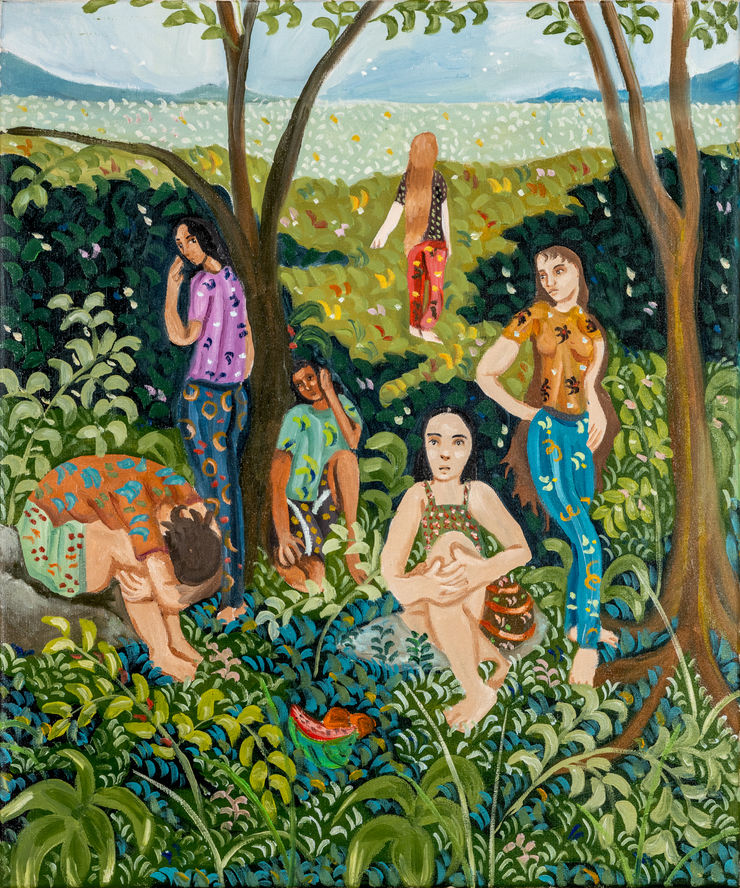
ABC-ARTE is pleased to present Arcádia Incerta, the new solo exhibition by Antonio Kuschnir (Rio de Janeiro, 2001) at the gallery’s Milan venue, with a critical contribution by Milovan Farronato.
The project originates from the pastoral imaginary, historically understood as a space of calm and compensation, and reinterprets it today as an unstable territory crossed by latent tensions and narrative ambiguities. In a time marked by the erosion of boundaries between the natural and the artificial, the Arcadian scene loses its innocence and becomes a fragile, exposed place in which beauty coexists with a subtle sense of unease. This tension runs through a pictorial practice that has already received institutional recognition, with works included in important public collections in Brazil, among them the National Museum of Fine Arts in Rio de Janeiro and the Museum of Contemporary Art of Niterói (MAC), where he became the youngest artist in the museum’s history to present a solo exhibition.
In Kuschnir’s paintings, nature is never a mere backdrop, but the stage for a complex mise-en-scène populated by figures suspended in a condition of waiting. Characters drawn from different temporalities and imaginaries inhabit the same space, as if the narrative were already underway and lacked a defined beginning. Rest, encounter, and danger coexist beneath a threshold of apparent harmony, while hybrid and symbolic presences blend into the landscape, turning threat into a latent condition rather than a manifest event. Works from this cycle are also part of the collection of the Presidency of the Federative Republic of Brazil and the São Paulo Cultural Diversity Center.
Kuschnir’s painting unfolds through progressive shifts: from a distance the scenes appear legible and narrative, but upon closer inspection bodies dissolve into ornamental surfaces dense with marks and colour, where figuration slows down and the gaze is held by the materiality of paint. Over the course of the exhibition, the Arcadian scene fractures, the light changes, and what had remained restrained emerges, brushing against conflict without ever resolving into a single, definitive conclusion.
Antonio Kuschnir began painting at the age of six, attending courses at the Escola de Artes Visuais do Parque Lage. Raised among forests, mountains, and the sea of Brazil’s tropical landscape, he developed at an early age a pictorial sensibility rooted in the symbolic power of natural elements. After completing his academic training between Rio de Janeiro and Europe, he now lives between Germany and Brazil and was recently an artist-in-residence at the La Napoule Art Foundation, in the south of France.
The pastoral scene, today, can no longer afford innocence. If for centuries it functioned as a space of compensation—an elsewhere that was gentle, idyllic, removed from conflict and from history—today that same image appears crossed by an internal friction, by a tension that cracks its promise of quiet. It is no coincidence that pastoral vocabulary has returned insistently within the language of contemporary art: not as a nostalgic citation or a stylistic repertoire, but as a symptom. In a time marked by climatic instability, by the erosion of the boundaries between the natural and the artificial, by the impossibility of thinking of nature as a neutral refuge, the pastoral scene ceases to be a locus amoenus and becomes a fragile, exposed field, traversed by contradictory forces. Its uncertainty concerns not only what happens within it, but its very status: what appears calm is no longer pacified, what seems immobile is traversed by time, by threat, by transformation. In this sense, an Arcádia incerta does not deny rest, but renders it ambiguous; it does not eliminate beauty, but exposes it to a subtle and persistent unease. It is a pastoral that does not promise salvation, but asks to be looked at with the awareness that, beneath the surface of harmony, something continues to move.
On closer inspection, however, this instability is not entirely foreign to tradition. In chivalric literature, the locus amoenus was never completely separated from its opposite: the horrific forest, the place of loss, deception, and trial. The meadows where maidens rest are always close to the woods in which one loses one’s way; the enchanted garden borders on the monstrous; magic and the marvelous do not erase danger, they mask it. In sixteenth-century poems, from the spells of Armida’s garden to sudden encounters with hybrid creatures, giants, or wandering knights, rest is often a threshold rather than a conclusion. Tancredi halts, Orlando loses himself, enchantment precedes rupture. The pastoral, even then, was an exposed place, where harmony could tip into conflict and apparent safety reveal itself as illusory.
It is within this ambiguous tradition—suspended between pleasure and threat, rest and waiting, deception and apparition—that the idea of an Arcádia incerta finds further depth in Antonio Kuschnir’s new series of paintings. Not an abstract landscape, but an inhabited scene, traversed by figures that seem to arrive from different times and origins, as if the story never truly begins, but were already underway. In one of the first paintings that introduce this world, three figures appear standing, frontally, isolated from any recognizable action. They do not rest, they do not fight, they do not seem involved in what surrounds them. They stand. Their garments, richly decorated, dominate the composition more than the bodies themselves: spirals, floral motifs, dense fields of color that attract the gaze and hold it on the surface of the painting. More than figures within a narrative, they seem like presences that have arrived to witness something. Who are they, then, and above all: what are they witnessing? Their posture suggests a silent, almost ritual waiting. It is possible—without this hypothesis closing the meaning of the image—that they recall the Magi: not as an explicit iconographic citation, but as a symbolic function, as figures who arrive from afar to attend an event that never fully coincides with the scene that hosts it. They bring no gifts, they point to no star, but appear held in a suspension laden with foreboding. This possibility gains further resonance if one considers the real space in which the exhibition takes shape. Beyond the gallery, facing the same square, rises the Basilica of Sant’Eustorgio, a place historically linked to the memory of the Magi. Not as a reference to be decoded, but as a frontal presence, as an echo that passes through the painting and the space that contains it. It is as if these three figures stand there, on the threshold, having come to witness a new nativity or an event that has not yet manifested, but that requires witnesses.
Waiting is a theme that the majority of the paintings on view dilate and disperse within a single scene that opens—literally—like a theater. A red curtain frames the landscape and declares what we are looking at: not a natural place, but a staging of nature. It is always the same space, recognizable and yet unstable, where the characters return, move, pursue one another, like actors who cross the stage multiple times without ever truly exiting the scene. In these paintings, figures often rest: they lie on the grass, touch one another, sleep, abandon themselves. The landscape that receives them is not a threatening forest, but an interweaving of shrubs, leaves, low plants, almost decorative. Nothing appears hostile, and precisely for this reason unease does not arrive as an event, but as a latent condition. Danger does not burst in; it camouflages itself. A dragon slowly emerges from the foliage, to the point that bodies can recline upon it without noticing. Snakes run along the margins of the scene, vertically or horizontally, like signs that delimit space more than active threats. Everything seems to happen beneath a threshold of attention, as if the world were charged with possibilities of violence or transformation that no one, at that moment, perceives.
It is here that Antonio Kuschnir’s painting reveals one of its decisive shifts. From a distance, the scene is legible: figures, gestures, relationships. As one approaches, however, bodies begin to dissolve into ornament. Garments become vibrating surfaces, dense textures of motifs, colors, repeated signs. Figuration progressively gives way to abstraction, not as a negation of narrative, but as its slowing down. The gaze is no longer carried forward by narration, but held by the painting itself. In this sense, the scenes recall the convivial suspension of Henri Matisse or Claude Monet’s construction of place as a visual experience: not so much through citation, as through a shared attention to surface, to light, to repetition as structure.
And yet, something changes. Slowly, almost without announcement, the season fractures. The light cools, the atmosphere becomes more rarefied. In one painting, a gigantic face emerges from the water like an uneasy apparition, a gaze that observes the scene from the outside, or perhaps from the future. It is difficult not to think of Francisco Goya: not for explicit violence, but for that visionary quality in which the world suddenly seems to look at itself. The landscape shifts toward winter, and with it the perception of time changes. We are no longer in an eternal suspension, but in a moment of passage that takes bodily form in a figure that advances. On horseback, bearing a weapon, he carries with him a cloth that resembles a banner. He is a figure of transition: he crosses the landscape as if announcing something, as if carrying night with him. In another painting, that same cloth becomes sky: stars, moon, birds. Here the artist explicitly enters the scene, recognizing himself as part of this world. It is a self-portrait, but not as the psychological center of the narrative: rather as a function. The one who crosses, who introduces darkness, who marks the passage from rest to event.
And the event, finally, occurs. The same scene—the same interweaving of plants, the same natural theater—explodes into battle. The large painting that closes this cycle does not break the previously constructed world; it carries it to its extreme consequences. Figures multiply, bodies crowd together, weapons cross. Swords, lances, and sabers coexist with rifles and pistols, mixing different temporalities in a single clash. Here the reference to Paolo Uccello is inevitable: not so much for composition, as for the idea of battle as a mental construction, as a device that orders chaos through the rhythm of figures and weapons.
The war, however, does not arrive from outside. It was already inscribed in rest, in the camouflaged dragon, in the suspension of bodies, in the banner carried across the landscape. Everything that seemed quiet was, in fact, preparing this moment. The pastoral has not transformed into battle: it always was one, only restrained, deferred, staged.
And yet, if the war has finally erupted, nothing obliges us to read it as an endpoint. Another painting—apparently more silent, almost lateral—introduces a decisive deviation. Two figures face one another, draw closer, touch hands. A snake coils around them, binds them, traces a knot that is both constraint and ornament. It is a marriage scene, or at least it seems so: not a solemn gesture, but a fragile, suspended agreement, immersed in the same vegetal matter that welcomed rest, the monster, the night, and the battle. Here the snake is neither temptation nor guilt. It becomes a decorative motif, a sinuous line that passes through the bodies and unites them, as if the very act of binding oneself were inseparable from risk. It is difficult not to think of a new Genesis, of an Adam and Eve who are not expelled from paradise, but who choose to inhabit it in its ambiguity. If this is an Eden, it is not innocent; if it is a paradise, it is already traversed by history.
At this point the narrative bifurcates, and no direction is truer than the other.
What, then, are the three figures who observed at the beginning—the witnesses, the travelers, perhaps the Magi—really witnessing? The battle, or its outcome? The war that is fought, or the pact that makes it necessary, or that attempts to repair it? The knight who carried the banner, who introduced the night and announced the change of season, might depart after victory, or precede the union, bringing darkness before a new day. The images offer no obligatory sequence: they function like combinatory literature, in which each painting can be a before or an after, a presage or a consequence.
It is within this narrative freedom that Kuschnir’s work finds one of its most fertile tensions. The history of European art—myth, pastoral, chivalric poem, battle, allegory—is never cited as a stable repertoire, but traversed as if by an anomalous wave. Seen from another latitude, filtered through a memory that grew elsewhere, these images intermingle without hierarchies: sacred and profane, ancient and contemporary, innocence and violence coexist within the same visual field, as if no level could definitively impose itself over the others. Marriage, then, does not close the narrative. It reopens it. It is not the answer to the battle, nor its negation, but another possibility of meaning, another arrangement of the same figures upon the stage. As if the world staged by Kuschnir did not ask to be interpreted once and for all, but continually recombined, reassembled, inhabited according to ever different orders.
As if all this were not enough, as if the scene were not already sufficiently unstable, a final painting introduces a concluding presence, almost out of time. A man sits on a chair in an interior made of draperies and curtains. He does not participate in the action, does not traverse the landscape, does not observe frontally like the initial figures. He watches. Or perhaps he observes out of the corner of his eye. His body is still, gathered; his gaze is not directed toward us, but seems to intercept something happening elsewhere, offstage. He could be behind the scenes, he could be on the other side of the curtain, or in a domestic space that mysteriously borders on the theater of the pastoral.
This figure clarifies nothing; on the contrary, it definitively complicates the narrative. If at the beginning there were standing witnesses, come from afar, here there is a graceful, immobile voyeur, almost clandestine. He is no longer the one who attends the event, but the one who watches over the scene as it unfolds, or perhaps as it is imagined. He is a spectator who resembles the spectator, and at the same time displaces them: we do not know whether he is watching what we have just seen, or whether he himself is being watched, in turn, from yet another point.
With this seated figure, apparently marginal, Kuschnir’s world closes without closing. The theater has no single front, the narrative has no stable beginning nor a definitive conclusion. Each scene can be observed from multiple positions, each image can be a center or a periphery, an event or its reflection. It is in this proliferation of gazes—more than in the resolution of stories—that Arcádia incerta finds its form: not as a narrative to be followed, but as a space to be inhabited, where meaning is not given once and for all, but remains, stubbornly, in suspension.
ABC-ARTE via XX Settembre 11/A, 16121 Genova
ABC-ARTE ONE OF via Santa Croce 21, 20122 Milano
La informiamo che, per migliorare la sua esperienza di navigazione su questo sito web www.abc-arte.com utilizza diversi tipi di cookie, tra cui: cookie di tipo funzionale alla navigazione (functionality cookie) che consentono di accedere a dati personali raccolti durante la navigazione. Nella pagina della Informativa Estesa che può consultare sono presenti le istruzioni per negare il consenso all'installazione di qualunque cookie. Cliccando su "ACCETTA" o continuando la navigazione, saranno attivati tutti i cookie specificati nell'Informativa Estesa ai sensi degli artt. 13 e 14 Reg.to UE 2016/679.
* denotes required fields
Informativa resa ai sensi degli art. 13-14 del GDPR (General Data Protection Regulation) 2016/679
Ai sensi del Regolamento (UE) 2016/679, questa pagina descrive le modalità di trattamento dei dati personali degli utenti che consultano il sito web di ABC-ARTE Srl (di seguito “Titolare del sito”) accessibile per via telematica all’indirizzo www.abc-arte.com (di seguito “Sito”). Le presenti informazioni non riguardano altri siti, pagine o servizi online raggiungibili tramite link ipertestuali eventualmente pubblicati nel sito ma riferiti a risorse esterne al dominio di wwwabc-arte.com
Titolare del trattamento:
A seguito della consultazione del sito sopra elencato possono essere trattati dati relativi a persone fisiche identificate o identificabili. Titolare del trattamento è: ABC-ARTE Srl, con sede legale in Piazza della Vittoria 11a/1b, 16121, Genova, IT
Tipi di dati trattati e finalità del trattamento:
Dati forniti volontariamente:
Attraverso il Sito è possibile inviare richieste e comunicazioni al Titolare del sito attraverso i forms e gli indirizzi di contatto riportati sul Sito. L’invio facoltativo, esplicito e volontario di messaggi agli indirizzi di contatto del Titolare del sito, nonché la compilazione e l’inoltro dei moduli presenti sul Sito, comportano l’acquisizione dei dati di contatto del mittente, necessari a rispondere, nonché di tutti i dati personali inclusi nelle comunicazioni.
Dati di navigazione:
In questa categoria di dati rientrano gli indirizzi IP o i nomi a dominio dei computer utilizzati dagli utenti che si connettono al sito, gli indirizzi in notazione URI (Uniform Resource Identifier) delle risorse richieste, e altri parametri relativi al sistema operativo e all’ambiente informatico dell’utente.
I dati di navigazione vengono acquisiti non per finalità di identificazione degli utenti, ma all’unico fine di raccogliere, in forma anonima, informazioni statistiche sull’utilizzo del sito e dei suoi servizi.
Modalità del trattamento:
I dati personali verranno trattati, nel rispetto delle norme vigenti, per mezzo di strumenti informatici e telematici e con logiche strettamente connesse alle finalità sopra indicate in modo da assicurare la riservatezza e la sicurezza dei dati stessi.
Tempi di conservazione dei dati:
I dati personali dell’utente saranno conservati solo per il tempo necessario alle finalità per le quali vengono raccolti nel rispetto del principio di minimizzazione ex art. 5.1.c) GDPR.
Interazione con social network e piattaforme esterne:
Questo tipo di servizi permettono di effettuare interazioni con i social network, o con altre piattaforme esterne, direttamente dalle pagine di questo sito. Le interazioni e le informazioni acquisite sono in ogni caso soggette alle impostazioni privacy dell’utente relative ad ogni social network. Nel caso in cui sia installato un servizio di interazione con i social network, è possibile che, anche nel caso gli utenti non utilizzino il servizio, lo stesso raccolga dati di traffico relativi alle pagine in cui è installato.
Base giuridica del trattamento:
La base giuridica dei trattamenti, per quanto riguarda le finalità sopra indicate, si può ricercare nel legittimo interesse del Titolare e nel consenso reso dall’interessato.
Diritti dell’interessato:
L’interessato, in relazione ai dati personali forniti, ha la facoltà di esercitare i diritti previsti dal Regolamento UE di seguito riportati:
L’interessato ha inoltre la facoltà di procedere, in ogni momento, alla revoca del consenso eventualmente prestato. I suddetti diritti possono essere esercitati in forma scritta, inviando una email a info@abc-arte.com